Going through the Panama Canal has been on my bucket list for as long as I can remember...can't really say why it's been on my list but there's just something about it that has always intrigued me.The first conversations about creating a canal to connect the Atlantic and Pacific Oceans was in the early 1500's to make it easier for ships to get between Spain and Peru. There were a few attempts but they never seemed to take hold for various reasons. In 1850, the United States began construction on the Panama Railroad as it was quicker for ships to sail to Panama, unload onto trains to get across the isthmus and reload onto to ships than to sail all the way down around Cape Horn.
As ships approach the first set of locks, three to four marine
pilots (aka seafarers) come out to board the ship. They are
the local experts and assist the captain with navigating the
canal to ensure a safe passage.

In addition to the pilots, each ship has a minimum of four tug boat along its side. The boats do not pull the ships but are there to ensure safe passage in the event the ship loses power or steering.
The completion of the Panama Railroad made it possible for the French attempt to build the canal in the late 1800's as it would be easier to get supplies and workers to the site. After 18 years and 22,000 deaths, the French project was bankrupt. In 1904, the US purchased the French equipment and excavations for $30M plus paid the new country of Panama $10M plus a guaranteed $250,000 each following and began work on what is now the Panama Canal. On August 15, 1914, the Panama Canal official opened and changed the way cargo and people moved between the oceans. In 1977, a treaty was signed that would turn over the Panama Canal to Panama on December 31, 1999 and the US sold the Panama Canal to Panama for $1. It cost the US $375M ($8B in today's dollars) to build the canal which includes payments to Panama and France and we sold it for $1 (just sayin').
Apparently we were veering a little to the left so the guys on the
dock tossed us a line and pulled us back on course as the tug boat
have to be aft and forward when inside the locks.
In 2007, after the Panamanians voted for an expansion, the work on expanding the canal began with the building of the new locks. Since the original locks (picture on left) were built, shipbuilding improved and ships became much larger making it challenging for them to fit through the locks without causing damage. On June 26, 2016, the new locks (the ones we used) were opened. The original locks are still in operation for the smaller vessels. The original locks had swing doors whereas the new locks have sliding gates which allows for more space and is much quicker.
While the new locks utilize tug boats, the old locks used "mules". These are little tractors used to assist the ships in the event of a power or steering failure but do not pull the ship through the canals. As we were passing the old locks, we could see several mules (see blue circle).
The Atlantic Bridge is the first approach to the Panama Canal coming from the Atlantic Ocean. We were told by our guide in Panama that in Panama they don't like to complicate things so they make the name easy (I can get behind that!). I wasn't able to get a full shot of the bridge but it looks like the Ravenel Bridge in Charleston. Clearly this is a popular style as we saw several while on the Mekong River in Vietnam last year.
The Agua Clara Locks are the Atlantic locks.

The new locks of Panama Canal are a double (meaning two lanes) two series of locks separated by a lake. When coming from the Atlantic Ocean, a ship enters the first lock and the gate closes behind. Water from the reserve pools begins to fill the lock to rise the ship to be equal to the second lock. Once equal to the second lock, the front gate slides back and the ship moves into the second lock and the process repeats. Once equal to the water in the third lock, the ship proceeds and the process repeats to bring the ship to the level of Lake Gatun the gate slides open and the ship process. As soon as our ship was in the lake en route to the second series of locks, a ship waiting in the lake took our place and headed towards the Atlantic. After a few hours, it was our turn to begin the second set of locks. This time, instead of water coming into the lock from the reserve pools, water was removed from the locks and put back into the reserve pools. We had another series of three locks to traverse before we entered the Pacific Ocean.
This is the ship you see on the right in the above
picture. Since the canal is dual lanes, two ships
can be in the locks at the same time.
Entering the first lock of Agua Clara
View of the sliding gates
Closing of the gate
The reserve pools are able to provide about 60% of the water necessary for the locks to operate. All of the water inside the locks and in Lake Gatun is fresh...the water in the first lock from each ocean is brackish as the water from the ocean does seep in as the gates open and close.
Markers letting ships know how far until the next lock
Water coming in from the reserve pools to bring us up to the level of the next lock. It is a subtle change but some times you could slightly feel the change.
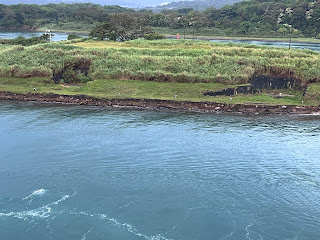
The El Nino from the Pacific Ocean has caused a severe drought in the Panama Canal. Water levels are approximately seven feet lower than the optimal amount. The effects of the drought could be seen along the shoreline as we passed through the canal. One of the things being done during the lower water levels is to limit the number of ships that can pass each day which has a ripple effect. Because ships can't be through, there are supply delays as well as increase in costs. One of the ways companies are getting around the reduced number of ship allowed to pass is going back to the old school ways and using the railroad. Ships will dock on the Pacific side of Panama and unload their cargo on to the trains and then reload them on another ship on the Atlantic side of Panama. This is still cheaper and faster than going all the way around the tip of South America.
The Pacific port of Panama
Not sure but it looks like the side of the hill is reinforced.
Photo credit: LuLu
National Geographic research ship
Waiting to enter the final locks
Opening of the locks
Cocoli Locks control tower and Bridge of Americas.
The Bridge of Americas is the Pacific entrance into the canal.
Now that we made it through the final locks,
this guy can enter. Wonder if he's on his
way to the port in Charleston?
We entered the locks around 6:30AM at Agua Clara and cleared the Cocoli Locks and were in the Pacific Ocean around 6:00PM. Going through the canal saves approximately 8,000 miles and about three weeks for each ship that passes. The convenience does come with a cost...a formula which was way too complicated to understand from our lecture. Our instructor said the estimated cost for our ship to pass through was roughly $500,000 which was approximately $175 per passenger. In 2022, Panama made a net profit of $2.1B (that's right billion) from canal tolls.
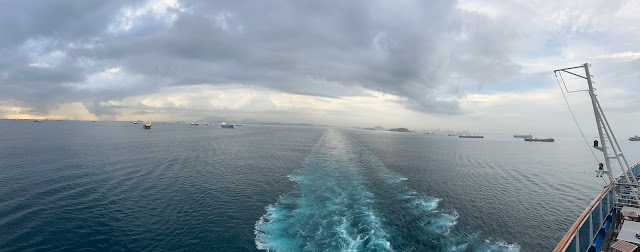 |
| Ships waiting to enter the locks from the Pacific |
After getting through the canal, we dropped anchor is the harbor for the night just outside of Fuerte Amador as the next day we booked an excursion to ride along the canal on the Panama Railroad. The Panama Railroad was the first transcontinental railway in the world and the trip took us back to the first lock on the Atlantic Ocean. As we arrived, we were just in time to see a ship enter and begin the process we underwent just 24 hours earlier.
When the US left Panama, the housing and old buildings
from the Navy Base reverted to Panama as well. Sadly
many of the buildings have not been maintained.
Cargo en route from the Pacific port to
the Atlantic port via Panama Railway
Most of the train ride from the Pacific to the Atlantic was through the jungle of Panama but every now and then we would get a glimpse of something other than trees.
Ship entering the Agua Clara locks
View of the entrance into the Panama Canal
from atop the Atlantic Bridge
It is rough work riding the train so we headed to the BBQ
restaurant on board for dinner. I must say, they passed the test
of three southerners! We enjoyed an Aperol Spritz and were
entertained by our server, LuLu (no kidding, his name is LuLu!).
We'll have a day at sea and then arrive at our next port in Costa Rica!